{
“@context”: “https://schema.org”,
“@type”: “Article”,
“headline”: “What Is a Piggyback ECU and Is It Worth It for Your Diesel Ute? (NZ Guide)”,
“description”: “A practical NZ guide to piggyback ECU tuning for diesel utes — how it works vs a full remap, how the Ultra Boost works, gains you can expect, compatible NZ vehicles, price, and install complexity.”,
“keywords”: “piggyback ECU NZ, tunable ECU ute NZ, diesel ECU tune NZ, Ultra Boost ECU NZ”,
“author”: {“@type”: “Organization”, “name”: “ECU Shop NZ”},
“publisher”: {“@type”: “Organization”, “name”: “ECU Shop NZ”},
“datePublished”: “2026-03-28”,
“mainEntityOfPage”: {“@type”: “WebPage”, “@id”: “https://ecushop.co.nz/piggyback-ecu-nz-guide/”}
}
If you want more power, more torque, and better fuel economy out of your diesel ute — without paying thousands for a full engine remap — a piggyback ECU is worth a serious look. But what exactly is a piggyback ECU, how does it differ from a full remap, and is it the right call for your Hilux, Ranger, Navara, D-Max, BT-50, or Triton here in New Zealand?
This guide covers everything you need to know before spending a cent.
What Is a Piggyback ECU vs a Full Remap?
Your diesel ute came from the factory with an Engine Control Unit (ECU) that governs how much fuel is injected, when it’s injected, how much boost the turbo produces, and dozens of other parameters. The manufacturer sets these conservatively — partly for emissions compliance, partly to give the engine a safe tune across a huge range of conditions, temperatures, and fuel qualities.
There are two main ways to improve on the factory tune:
Full ECU Remap (Flash Tune)
A full remap involves connecting to the vehicle’s OBD port (or direct to the ECU) and rewriting the factory maps stored inside the ECU. Done by a skilled tuner with a dyno, this can unlock significant power gains and is the “permanent” approach to tuning.
Downsides: it’s expensive ($500–$1,500+ depending on the tuner and vehicle), it permanently modifies the factory ECU (usually voids remaining manufacturer warranty), and it’s not reversible without a re-flash back to factory tune. Finding a quality tuner in regional NZ can also be challenging.
Piggyback ECU (Add-On Tune)
A piggyback ECU — also called an add-on tune module or tuning module — sits between the factory ECU and the engine’s sensors and actuators. It intercepts and modifies the signals in real time: increasing fuel quantity, advancing timing, managing boost pressure — without touching the factory ECU’s stored maps.
The factory ECU stays completely unmodified. You get the performance gains without the permanence or the price of a full remap. And if you ever need to take the vehicle to a dealer or want to restore factory settings, you simply unplug the piggyback module and your ECU is exactly as it left the factory.
How the Ultra Boost Works
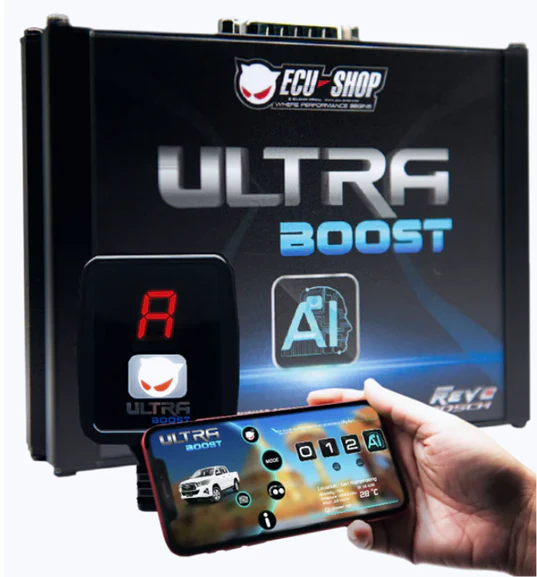
ECU Shop NZ’s Ultra Boost piggyback ECU is our go-to recommendation for NZ diesel ute owners wanting real, measurable performance gains in a clean, plug-and-play package.
Here’s what happens under the bonnet:
- Fuel signal adjustment: The Ultra Boost intercepts the injector signal and increases fuel delivery beyond the factory limit — more fuel means more combustion energy and more torque
- Boost pressure management: The module adjusts the boost signal to the turbocharger wastegate, increasing boost pressure within safe limits for the engine
- Real-time operation: The module reads RPM, load, and temperature signals and adjusts its intervention map accordingly — so gains are consistent across the rev range, not just at one point
- Vehicle-specific calibration: Unlike generic modules, the Ultra Boost comes pre-calibrated for your specific engine variant, so you’re not starting with a one-size-fits-all map that may be too aggressive or too timid
The result is a broader, flatter torque curve — the kind of pull that makes towing a loaded trailer up the Remutaka Hill feel effortless, or lets you confidently merge onto the motorway even when you’re hooked up to a boat or horse float.
Performance Gains You Can Expect
Results will vary depending on your vehicle, engine condition, and fuel quality. Here’s a realistic picture of what Kiwi diesel ute owners typically see with the Ultra Boost:
- Power: 20–40 kW gain (varies by engine)
- Torque: 60–120 Nm gain — this is where you really feel it
- Fuel economy: Up to 10–15% improvement on highway/touring — more efficient combustion means more distance per litre
- Towing performance: Noticeably reduced gear changes on hills, easier throttle modulation when loaded
- Throttle response: Sharper, more immediate response without the factory lag
Gains are most noticeable in the mid-range (1,500–3,500 RPM) where diesel utes spend most of their working life. This is the load range that matters for towing, farm work, and loaded highway driving — all bread-and-butter NZ ute use cases.
For an extra layer of responsiveness, pair the Ultra Boost with a Boost Speed Next V2 throttle controller — the two work independently and complement each other well.
Compatible NZ Diesel Utes
ECU Shop NZ stocks Ultra Boost units for the most popular diesel utes in New Zealand. Here’s a snapshot of compatible vehicles:
- Toyota Hilux — 1KD-FTV (3.0L), 1GD-FTV (2.8L)
- Toyota Hiace — 1KD-FTV, 1GD-FTV
- Ford Ranger — PX1/PX2/PX3 3.2L, PJ/PK 3.0L, 2023+ 2.0L Bi-Turbo
- Ford Everest — 3.2L variants
- Nissan Navara — D23, D40
- Isuzu D-Max — 4JJ1 3.0L, 4JJ3 3.0L
- Mazda BT-50 — 3.0L, 3.2L (no DPF)
- Mitsubishi Triton — 4N15, 4D56
- Holden Colorado — RC, RG
Browse the full Ultra Boost range by vehicle here, or contact us to confirm fitment for your specific build date and spec.
Price: What Does a Piggyback ECU Cost in NZ?
The Ultra Boost is priced to be a genuine mid-ground option between a cheap generic tune box and an expensive dyno remap:
- Ultra Boost module: Priced competitively against full dyno remaps — typically a fraction of the cost at around NZ$400–$600 depending on vehicle variant
- Installation: DIY-friendly — most owners fit it in 30–60 minutes (see below). No workshop labour required.
- Total cost of ownership: Substantially lower than a dyno remap, with the added benefit of being fully removable
Compare that to a quality dyno remap in NZ, which can cost $800–$1,800+ depending on the tuner and whether custom mapping is required. The Ultra Boost delivers a meaningful portion of those gains at a much lower entry cost.
Install Complexity
The Ultra Boost is designed for DIY installation. Here’s what to expect:
Tools required:
- Basic socket set
- Flathead screwdriver
- Zip ties (included)
- 30–60 minutes
Installation overview:
- Locate the injector wiring harness and boost pressure sensor on your engine (vehicle-specific instructions are included)
- Plug the Ultra Boost harness connectors in-line — it uses OEM-style connectors for a secure, rattle-free fit
- Mount the compact module in the engine bay using the provided bracket or zip ties
- Start the engine and check for normal operation — no configuration required, the unit is pre-calibrated from the factory for your vehicle
Most Kiwi DIY-ers with basic mechanical confidence get through the install without issues. If you prefer, any workshop can fit it in under an hour. No specialist diagnostic equipment is required.
If you’re also looking to clean up your EGR system, pairing the Ultra Boost with an EGR delete cable is a natural combination — keep the intake clean while the Ultra Boost optimises what goes through it.
Frequently Asked Questions
Will a piggyback ECU void my warranty?
Because the factory ECU is never modified, a piggyback ECU is much less likely to affect your warranty than a flash remap. That said, if a dealer can identify the module and link it to a specific fault, they may attempt to use it as grounds to decline a warranty claim. For vehicles still under manufacturer warranty, check with your dealer. For out-of-warranty utes — the vast majority of working NZ diesel utes — this isn’t a concern.
Is it safe for my engine?
Yes — the Ultra Boost is calibrated to stay within safe limits for your specific engine. It doesn’t push fuel or boost beyond the engine’s structural tolerances. Ensure your engine is in good condition (no oil leaks, clean air filter, healthy turbo) before fitting any performance module.
Does it work with automatic and manual gearboxes?
Yes. The Ultra Boost works with both auto and manual transmissions. Note that if you have an auto, the increased torque may prompt the gearbox to shift slightly earlier — most owners find this improves the driving experience.
Can I run the Ultra Boost with a throttle controller?
Yes. The BSN V2 throttle controller and the Ultra Boost ECU operate independently and complement each other. The throttle controller sharpens your pedal response, while the Ultra Boost increases the actual power output available once the throttle opens.
What if I need to return to factory tune for a dealer service?
Simply unplug the Ultra Boost and reconnect the factory harness. The process takes about 10 minutes and leaves no trace. Reinstall it after the service if you choose.
Will it improve my fuel economy?
Many owners report a 10–15% improvement in fuel economy on highway runs, because more complete combustion extracts more energy from each injection. In-town economy is less affected, as it depends more on driving style.
Ready to unlock your diesel ute’s full potential? Browse our Tunable Piggyback ECUs for NZ diesel utes or contact us to find the right unit for your vehicle.
Also read: EGR Delete Cables: The Complete NZ Guide | BSN V2 vs iDrive vs EVC: Throttle Controller Comparison


